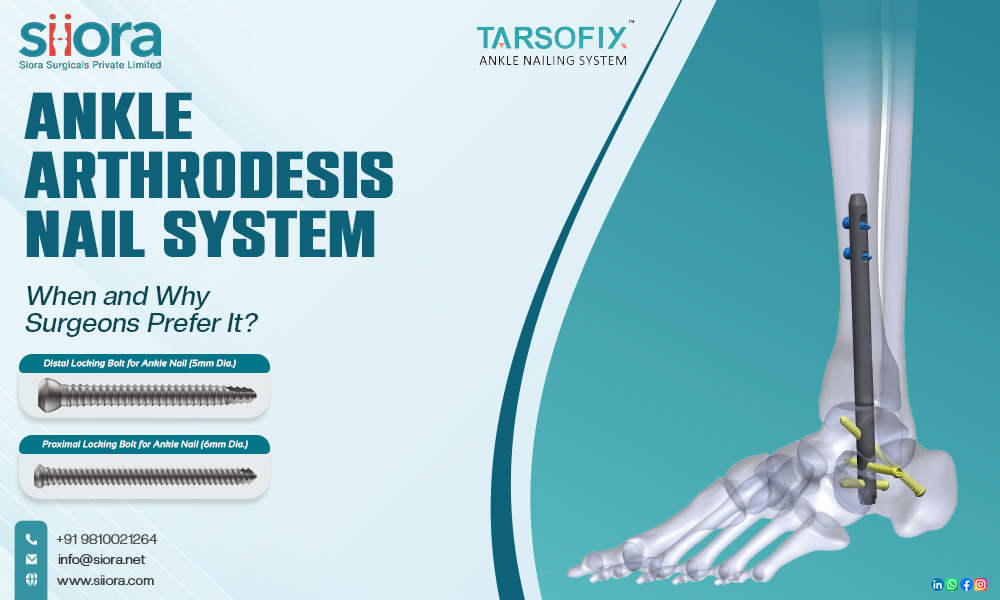
Anyone who has lived with advanced ankle arthritis or a poorly healed injury knows how much every step can hurt. For some people, pain medications and braces keep things manageable for a while, but eventually the ankle joint wears down to the point where daily life becomes exhausting. At that stage, surgeons often recommend ankle fusion, and in recent years, many of them have shown a strong preference for using the ankle arthrodesis nail system.
What Ankle Fusion Means for Patients?
Ankle arthrodesis isn’t a new concept. Surgeons have been fusing painful ankle joints for decades to give patients relief when nothing else works. The idea is straightforward: instead of trying to preserve a severely damaged joint, the surgeon locks the bones together so they heal into a single, stable unit. Yes, it means losing movement at that joint, but the win is significant—patients usually get rid of the sharp, grinding pain that made walking nearly impossible.
How Nail Systems Changed the Approach?
Earlier, surgeons relied heavily on plates and screws to fix bones after the fusion procedure. While effective, these methods sometimes struggled in complicated cases or when the bone quality was poor. The nail system changed things. Rather than sitting on the outside of the bone, the nail anchors itself right through the inside, running down the tibia and into the foot. Think of it as the difference between propping a door shut from the outside versus running a strong bar through the middle—it’s simply more secure.
Situations Where Nails Are the Better Choice
Surgeons don’t use this system for every case. It’s usually reserved for situations that need extra stability or involve high risk of failure. A few examples:
- Someone with end-stage arthritis, where the joint is so worn down that nothing else relieves the pain.
- A patient with a failed ankle replacement, when an artificial ankle no longer works and needs to be converted into a fusion.
- Severe bone deformities, like when the ankle collapses to one side, making walking not only painful but unsafe.
- Charcot neuropathy, a condition often linked to diabetes that leaves the ankle unstable and fragile.
- Revision cases, where prior surgery didn’t heal properly using screws or plates and requires a stronger approach.
Why Surgeons Value the Nail System?
Ask a group of orthopedic surgeons why they prefer nails in tough cases, and most will give practical answers:
- The nail sits at the center of the bone, so it carries load more effectively than hardware fixed only to the surface.
- Because the implant is inside, it doesn’t stress the surrounding soft tissue as much—patients with sensitive skin or poor circulation benefit from this.
- Nails allow better alignment, and most studies show they promote higher fusion rates than plates alone.
- In the right patients, weight-bearing begins earlier, which shortens recovery time compared to more restrictive methods.
- The implants have become more adaptable. With locking screws and curved shafts, surgeons can customize stability for very specific anatomical challenges.
Things Surgeons Still Weigh Carefully
Ankle fusion with a nail is not a one-size-fits-all answer. If a patient is very elderly, has extremely poor bone quality, or carries a high infection risk, the surgeon might look at other options first. There are also occasional complications, like irritation in the tibia or a fusion that heals slower than expected. That said, with today’s improved orthopedic implant designs, most surgeons find the balance of benefit over risk overwhelmingly positive.
In the End
For patients, the ankle arthrodesis nail system often represents the first real chance to walk without constant ankle pain. For surgeons, it combines stability, predictability, and adaptability in complex situations. It has become a kind of “go-to” option when traditional fixation doesn’t feel reliable enough. At its heart, this isn’t just about fusing joints—it’s about restoring confidence, mobility, and independence for people who thought they might never get back to walking comfortably again
 Orthopedic Implants Suppliers
Leave a comment